Last Updated: October 25, 2026
Quick Summary
To prepare your driveway for a Palouse winter, clear all junk and debris, sweep off leaves and loess dust, pressure wash the concrete, check drainage for low spots, and fill small cracks before the first hard freeze. Good driveway winter prep also means moving vehicles, bins, and firewood off the slab and planning where snow will be piled so meltwater drains away instead of refreezing.
- Clear junk, lumber, and yard debris first, since anything on the slab traps moisture.
- Sweep or blow off cottonwood leaves and loess dust, pushing debris off the slab, not into corners.
- Pressure wash concrete and hard surfaces only, keeping the wand moving so you don’t etch the surface.
- Walk the driveway after rain to find low spots where meltwater will pool and refreeze.
- Pile snow on grass or landscaping, not on concrete, and keep piles away from downspouts.
Table of Contents
- Why a Palouse Winter Is Hard on Concrete Driveways
- Your Winter Driveway Maintenance Checklist
- How to Pressure Wash a Concrete Driveway Before Winter
- Check Your Driveway Drainage Before Winter
- Inspect for Cracks and Surface Damage
- Where to Pile Snow on a Driveway
- De-Icers, Sand, and Traction: Protecting the Surface
- Let Me And My Truck Handle the Heavy Prep
- Frequently Asked Questions
Why a Palouse Winter Is Hard on Concrete Driveways
A Palouse driveway winter is a freeze-thaw machine, and your concrete slab sits right in the middle of it.
Days hover above freezing and melt the snow. Nights drop well below and refreeze every drop of that meltwater.
Then there’s the local grit. Loess dust blows in and settles in every low spot. Cottonwood leaves and seed fluff pile up against the garage door.
This guide from Me And My Truck covers how to prepare your driveway for a Palouse winter, step by step. For more straight-talk home maintenance tips for Moscow and Pullman homeowners, see Home Tips From the Palouse.
Your Winter Driveway Maintenance Checklist
A winter driveway maintenance checklist for the Palouse has eight jobs: clear debris, sweep, wash, check drainage, inspect for cracks, move vehicles and bins, plan snow storage, and stock traction material. Most of it you can do in a weekend.
Here’s the short version you can print and stick on the garage wall:
- Haul off junk, old lumber, and yard debris
- Sweep or blow off leaves, cottonwood fluff, and loess dust
- Pressure wash the concrete and hard surfaces
- Check drainage and note any low spots or puddling
- Inspect for cracks and surface damage
- Move vehicles, bins, and firewood off the slab
- Decide where snow will be piled
- Stock sand or grit for traction
Work through it top to bottom. Each step makes the next one easier.
Clear Junk, Yard Debris, and Summer Clutter
Start with the stuff that shouldn’t be there. Old planters, broken patio chairs, a stack of lumber from a project you finished in July. Anything sitting on the slab traps moisture and gives leaves a place to pile up.
Walk the driveway with a critical eye and sort into three piles: keep, donate, and haul. The haul pile is usually bigger than people expect. If you’d rather not make the trip yourself, our junk removal service in Moscow and Pullman handles furniture, appliances, and yard debris, and you can text a photo to (208) 882-5641 for a quick quote.
Sweep and Blow Off Leaves and Loess Dust
Once the big stuff is gone, get the surface clean. Loess dust is fine and silty, and it settles into every crack and low corner. Cottonwood leaves break down into a slick, matted layer that holds water against the concrete.
Use a leaf blower for the bulk, then a stiff broom for the stubborn grit. Push everything off the slab, not into the corners.
Here’s the whole checklist in one place, with what each job involves.
| Step | What to do |
|---|---|
| Clear clutter | Haul off junk, old lumber, and yard debris |
| Sweep and blow | Remove leaves, cottonwood fluff, and loess dust |
| Pressure wash | Clean concrete and hard surfaces only |
| Check drainage | Note low spots or puddling |
| Inspect | Look for cracks and surface damage |
| Clear the slab | Move vehicles, bins, and firewood off |
| Plan snow storage | Decide where snow will be piled |
| Stock traction | Keep sand or grit on hand |
How to Pressure Wash a Concrete Driveway Before Winter
Pressure washing a concrete driveway before winter removes the embedded dirt, moss film, and grime that a broom can’t reach. A clean slab dries faster and shows you cracks you’d otherwise miss.
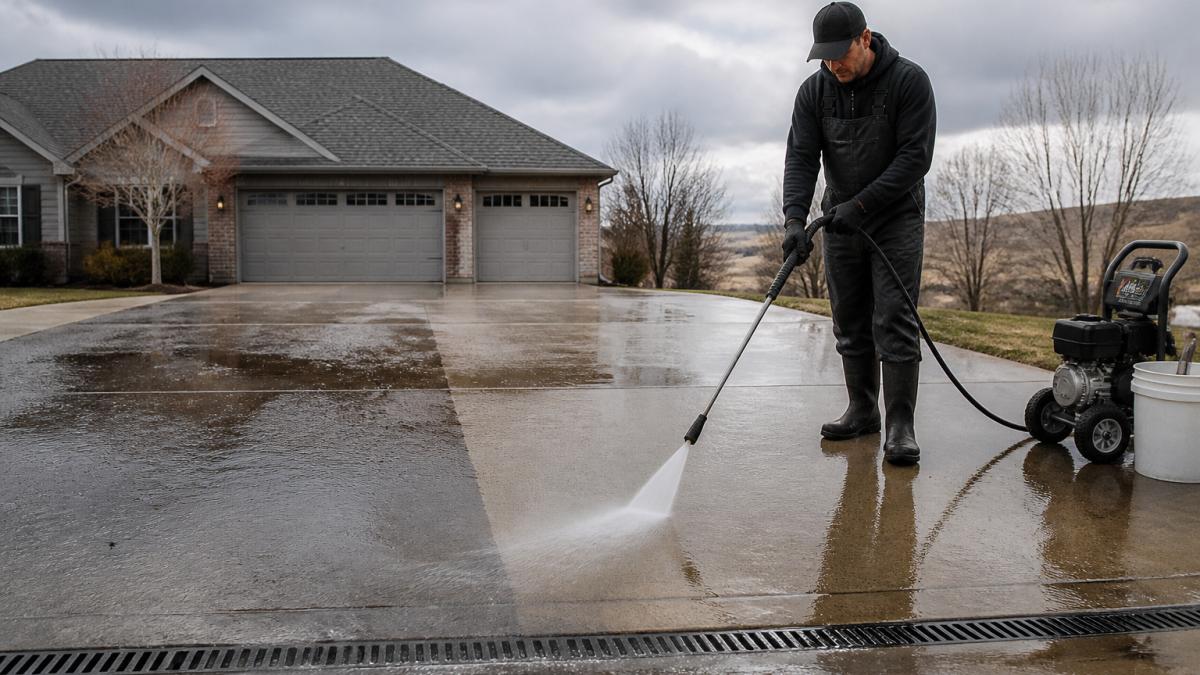
Here’s how to do it right:
- Pick a dry day with a few hours of sun ahead so the concrete can dry.
- Clear the surface completely first, since debris clogs the spray path.
- Work in sections, top to bottom, so dirty water runs off the clean area.
- Keep the wand moving. Holding it in one spot etches the surface.
- Rinse the whole slab, then let it dry fully before you inspect it.
Watch out: pressure washing is for concrete and hard surfaces only. Never point a pressure washer at siding, and never use one on a roof. If you’d rather skip the hose and the soaked shoes, Me And My Truck pressure washes concrete and hard surfaces.
Check Your Driveway Drainage Before Winter
Drainage is the driveway winter step most people skip, and it’s the one that matters most. Meltwater has to go somewhere. If it can’t, it pools, freezes, and starts working its way into the slab.
Walk your driveway after a rain and watch where the water goes. It should sheet off toward the street, a drain, or the yard. If it sits, you’ve found the spot that will turn into an ice rink in January.
Watch for Puddling and Low Spots
A low spot is a puddle waiting to freeze. Note where water stands, and note how big the area is. Small dips can often be cleared by making sure the surrounding debris and soil aren’t blocking the flow.
Also check that gutters and downspouts are sending water away from the driveway, not onto it. If your gutters are packed and overflowing, that’s a job worth handling before the rain starts, and our gutter cleaning service clears them by hand and hauls the debris away.
Inspect for Cracks and Surface Damage
Cracks are where winter gets in. A hairline crack looks harmless in October. By February, freeze-thaw cycles have widened it, and by spring you’ve got a crumbling edge.
Get down close and look, or run your hand along the surface. Check the edges, the seams, and the area where the driveway meets the garage slab. Mark anything you find.
Small cracks are usually a job for a concrete crack filler from the hardware store. Larger cracks, crumbling edges, or big spalled patches are worth a call to a concrete repair company.
Where to Pile Snow on a Driveway
Plan your snow piles before the first storm, not during it. Where you pile snow decides whether meltwater drains away or refreezes across your slab.
A few rules of thumb:
- Pile snow on the grass or landscaping, not on the concrete. Snow piled on the slab insulates the ice underneath and slows the melt, which means more refreeze cycles.
- Keep piles away from the garage door and the downspouts. A pile against the downspout blocks the outlet, and the next rain backs water up against the slab edge.
- Leave the low corner of the driveway clear so meltwater can escape. That’s the spot you identified when you checked drainage.
- Don’t pile against the house foundation or block a drain. Meltwater needs a path away from the structure, not toward it.
- Keep the pile back from the street edge enough that plow trucks have room to work and don’t shove it back onto your apron.
Here’s the mechanism to keep in mind. Snow piles melt from the bottom and the sunny side. That meltwater runs downhill.
If you run a business with a parking lot, this planning matters even more. Where the plow stacks snow decides which corners of the lot ice up and which drains stay open.
De-Icers, Sand, and Traction: Protecting the Surface
De-icers are where a lot of Palouse driveways get hurt.
The mechanism matters. Ice melts when the de-icer pulls the freezing point of the water down. Different products do that to different depths and at different temperatures.
Why rock salt is hard on concrete: when salt dissolves, it draws moisture into the slab’s pores. Every time that moisture refreezes, it expands.
A practical order of operations for a Palouse driveway:
- Shovel or blow the snow off first. De-icer is for the thin layer and the ice bond, not for a foot of snow.
- Use sand or grit for traction on concrete. It doesn’t melt anything, but it gives you grip and it won’t chew up the slab. Keep a bucket by the garage door and a scoop in it.
- If you need melting, spread calcium chloride or magnesium chloride lightly and evenly. More product doesn’t mean more melting. Piles of de-icer just sit on the surface and refreeze into a slushy mess.
- Keep rock salt for bare asphalt, not concrete, and keep it away from planting beds and the lawn edge.
- Sweep up leftover sand and grit in the spring before it washes into the storm drain or gets tracked into the garage.
Never use fertilizer as a de-icer, and never shovel snow onto a pile of salt. Both make a mess of your slab and your lawn, and neither does the job you’re hoping for.
A note on timing: the Palouse usually gets its first real snow somewhere in the late fall, but the freeze-thaw cycles that do the damage start earlier, on clear nights when the driveway is wet from rain or dew. That’s the window to have your traction material staged and your de-icer choice made, not the morning of the first storm.
If you run a commercial lot, the same rules apply, just at a bigger scale.
Let Me And My Truck Handle the Heavy Prep
The prep work is doable on your own, and if you’ve got a free Saturday, have at it. But if the junk pile is bigger than the truck bed, or the pressure washing sounds like a chore you’d rather hand off, we’re happy to help.
Me And My Truck has been taking care of Palouse homes and businesses since 1987. We know loess dust, cottonwood season, and what a Moscow or Pullman winter does to a driveway. If you’d like a hand with the heavy prep, get a free quote and we’ll take a look.
Frequently Asked Questions
How do I prepare a concrete driveway for winter?
Start by clearing all junk, leaves, and loess dust so you can see the surface. Check for cracks and low spots that will hold water. Pressure wash the concrete if it needs it, then let it dry fully. Plan where snow will go so it doesn’t block drainage or get pushed back onto the slab. Move bins, firewood, and vehicles off the surface before the first freeze so meltwater can run off instead of pooling and refreezing.
When should I clean my driveway before the first snow?
In the Palouse, aim to finish your driveway winter prep in early to mid-fall, before the first hard freeze sets in. Leaves and cottonwood debris need to be off the surface before they get wet and matted down. If you pressure wash, do it on a dry stretch so the concrete has time to dry out. Once freezing temperatures arrive, water on the slab can refreeze overnight and cause problems.
How do I keep meltwater from pooling on my driveway?
Walk the driveway after a rain and note where water sits. Clear leaves and debris from the edges and any drainage path so runoff can escape. If a low spot holds water, that’s where ice will form first. Keep snow piles off the slab and away from the drainage path. For bigger drainage issues, Me And My Truck can take a look and point out what we see.
Should I pressure wash a concrete driveway before winter?
Pressure washing concrete is a good way to strip loess dust, grime, and stains before winter, and it lets you see cracks and surface damage clearly. Only pressure wash concrete and hard surfaces, never roofs or siding. Do it on a dry day and let the slab dry fully before freezing weather. If you’d rather not tackle it, Me And My Truck pressure washes concrete and hard surfaces. Call or text (208) 882-5641.
A Palouse winter doesn’t have to wreck your driveway. A weekend of prep now saves you a spring of repairs later. If you’d rather hand off the junk hauling or the pressure washing, Me And My Truck is right here in town. Call or text (208) 882-5641 or send a photo for a free quote.