
Table of Contents
- Why Cottonwood Plugs Gutters So Fast on the Palouse
- Gutter Cleaning Safety Tips Before You Climb
- Tools That Actually Pull Cottonwood Out
- How to Clean Cottonwood From Gutters: Step by Step
- How to Flush Downspouts Without Making a Mess
- Timing Your Cleanings Around Peak Bloom
- When to Stop and Call Me And My Truck
- Frequently Asked Questions
Last Updated: October 1, 2026
Why Cottonwood Plugs Gutters So Fast on the Palouse
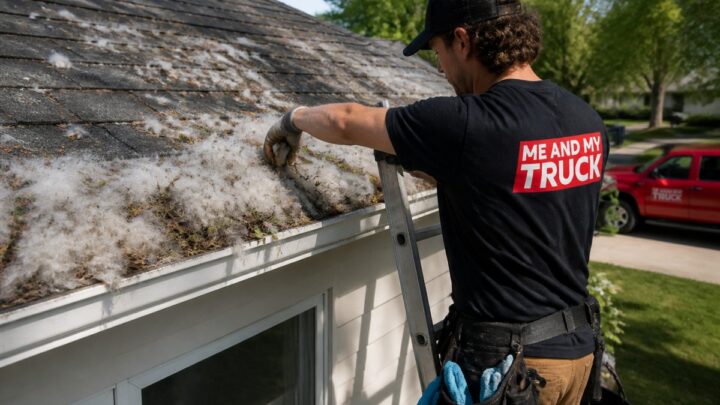
Learning how to clean cottonwood from gutters starts with why this stuff is different from ordinary leaves. Cottonwood fluff is the white seed fiber that drifts off female cottonwood trees each spring. On the Palouse, that drift turns into a blizzard.
What Cottonwood Fluff Does Once It Hits Water
Cottonwood fluff binds into a dense, water-resistant mat once it gets wet. That mat seals the trough like a lid, so water can’t reach the downspout, debris piles on top, and the mat gets heavier and presses down. One good storm can clog a clean gutter in an afternoon.
The Damage Overflow Causes to Foundations and Siding
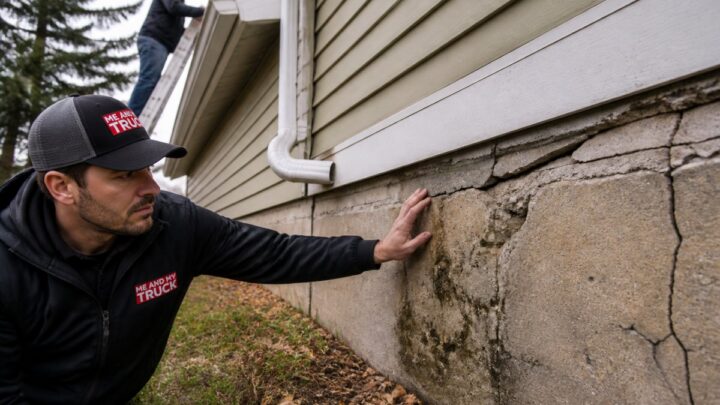
When a gutter can’t move water, that water goes somewhere, usually down the side of your house. Overflowing gutters send roof runoff straight to your foundation, which means soil erosion, water pooling where it shouldn’t, and staining and rot on siding. Foundation damage from gutter overflow is slow and stubborn. You rarely notice it until it’s a real problem.
A gutter that looks fine from the ground can be completely sealed under a cottonwood mat. Water backs up, overflows the back edge, and soaks the fascia before you ever see a drip.
Gutter Cleaning Safety Tips Before You Climb
Gutter cleaning safety tips matter more than speed. Most gutter injuries come from rushing, not height.
Set yourself up right before you touch a ladder:
- Wait for dry conditions. Wet rungs and wet roofs are how people fall.
- Wear soft-soled shoes with good grip.
- Set the ladder on firm, level ground and lean it at a safe angle.
- Keep your hips between the rails. Don’t overreach.
- Move the ladder instead of stretching for that last handful.
- Take it slow. If you’re not comfortable up there, don’t go up.
Tools That Actually Pull Cottonwood Out
The right tools make cottonwood removal fast. The wrong ones make it a wrestling match. And the tool that works on dry leaves is often wrong for a wet cottonwood mat.
Hand Tools That Earn Their Keep
- Heavy rubber gloves. Cottonwood sticks to bare hands and to cotton gloves. Rubber lets you peel the mat instead of picking at it.
- A sturdy bucket with a hook. Hang it from the ladder so both hands stay free. Five gallons is the right size.
- A gutter scoop or a stiff plastic scoop. Plastic won’t scratch the trough. Metal scoops leave bright scratches on painted gutters.
- A small hand trowel for packed corners and around hangers.
- A garden hose with a spray nozzle for the flush. A fan setting beats a jet, a jet drives crumbs into the downspout.
- A plumber’s snake or a stiff wire for downspout clogs.
- A tarp on the ground to catch the mess. Cottonwood crumbs that hit bare grass are almost impossible to rake up.
The Wet-Dry Vac Question
A wet-dry vac is the one tool that splits opinion, so here’s the honest trade-off.
What Doesn’t Work
- A leaf blower on wet fluff. It smears it around and pushes fiber into the downspout. On dry fluff it can work, but only if you’re blowing away from the downspout.
- A pressure washer inside a gutter. It drives debris into the downspout, tears at the seams, and can strip the paint off the fascia. Never use one inside a gutter.
- A shop broom. Cottonwood wraps around the bristles and you end up carrying a broom-shaped mat around the roof.
Clearing a Plugged Downspout
A plugged downspout is its own job, and the tool matters.
- From the top: feed a plumber’s snake down from the downspout opening. Work it in short pushes. Don’t force it, you’ll kink the snake or pop a joint.
- From the bottom: if the outlet is reachable, a hose with a jet nozzle pushed up from the bottom can break a plug loose. Have someone at the top watching for the release.
- If the downspout has an elbow, the plug is almost always at the bend. Snake from the top and stop when you feel resistance at the elbow.
One More Thing Most Guides Skip
Bring a trash bag up with you, or hang one from the ladder. Bagging as you go beats climbing down every ten minutes, and it keeps loose fluff from blowing back onto the roof.
How to Clean Cottonwood From Gutters: Step by Step
Here’s the full process, start to finish. Work one section at a time, and don’t move the ladder until that section is clean.
Step 1: Read the Trough Before You Touch It
Before you pull anything, look. Cottonwood gives you clues about where the plug is hiding.
- Standing water in the trough means the plug is downstream of that water, not under it.
- A dry trough with a green or black stain line means the mat has been there a while and the fiber has bonded to the metal.
- Fluff piled higher in one section usually means that section is the shallowest point, or the hanger is sagging just enough to catch fiber.
- A downspout outlet that drips slowly during rain means the plug is at the outlet, not mid-run.
Step 2: Clear the Troughs by Hand, Working Away From the Downspout
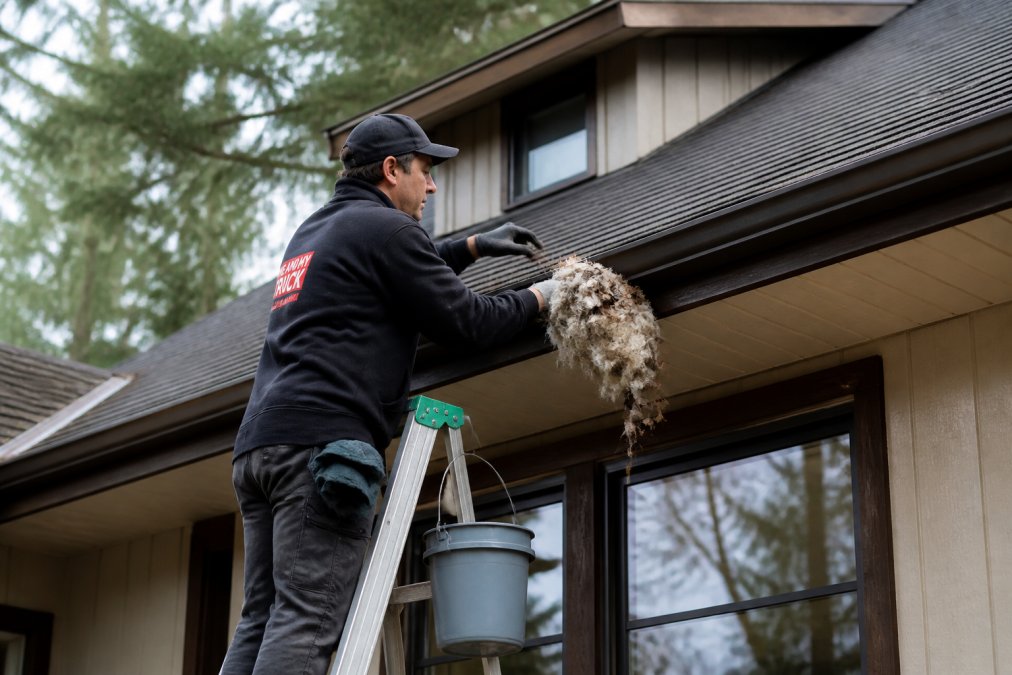
Start at the downspout end and work away from it. Pull the loose fluff and debris out by hand and drop it in your bucket or bag. Don’t sweep it toward the downspout, that just pushes the clog downstream.
Step 3: Break Up Matted Plugs, the Part Nobody Explains
This is where cottonwood is different from leaves. A cottonwood plug isn’t a pile of debris sitting in a trough. It’s a felted sheet of fiber knitted to the metal, sometimes to the hanger, and often into the downspout opening.
Here’s how to take it apart:
- Find the high side of the plug. Water sits on the upstream side. That’s your entry point.
- Score the mat, don’t scoop it. Run the edge of your plastic scoop along the seam where the mat meets the trough wall. Lift an edge instead of digging through the middle, digging compresses the fiber and makes it denser.
- Peel in strips. Once you have an edge, peel the mat up in strips about as wide as your hand. A whole mat lifted at once will tear at the hanger or drop into the downspout.
- Watch the downspout opening. As soon as you free the mat near the outlet, check it. Half the plug is often already sitting in the drop tube, out of sight.
- If the mat has dried and bonded to the metal, wet it first. A slow trickle from a hose softens the bond and lets the scoop slide under.
- If the mat is still wet and heavy, work it in smaller pieces. Wet cottonwood weighs far more than it looks.
Step 4: Bag It and Haul It Away
Bag everything as you go. Cottonwood fluff is light when dry and heavy when wet, so a full bag gets surprising fast. Tie off each bag and set it somewhere it won’t blow back into the gutter.
If the mat is fighting you, stop and wet it. A dry cottonwood mat crumbles into fiber crumbs that fall back into the trough. A wet mat peels in one piece. Counterintuitive, but it’s the single biggest time-saver on this job.
Step 5: Recheck the Run Before You Move the Ladder
Before you climb down, run your gloved hand along the bottom of the section you just cleared. You’re feeling for leftover fiber crumbs and any spot where the trough bottom feels rough or gritty. Grit means the mat left residue, and that residue will catch the next round of fluff faster than clean metal will.
How to Flush Downspouts Without Making a Mess
Flushing downspouts is the step that proves whether you actually cleared the clog. A gutter can look spotless while the downspout stays plugged.
Here’s how to flush without soaking your siding:
- Point the hose down the downspout from the top.
- Have someone watch the bottom outlet.
- If water backs up, you’ve still got a clog. Feed a plumber’s snake down from the top.
- Work the snake in short pushes. Don’t force it.
- Run water again until it flows free at the bottom.
Timing Your Cleanings Around Peak Bloom
Timing beats effort here. Cottonwood season on the Palouse runs through late spring into early summer, and peak bloom is when the fluff flies hardest.
Watch for the signs that you’re due:
- Fluff visibly sitting in the trough
- Water dripping over the front edge during rain
- Staining on the fascia below the gutter
- Plants below the downspout outlet looking washed out
Walk your gutters from the ground after the first hard spring rain. If you see water sheeting over the front edge anywhere, that section is already clogged. You don’t need to climb up to diagnose it.
When to Stop and Call Me And My Truck
Some jobs are a Saturday afternoon. Some aren’t.
Call it a day if:
- Your gutters sit higher than you’re comfortable with
- The roof pitch is steep
- Your ladder can’t sit level on the ground
- Power lines run close to the roofline
- You’ve got a two-story drop and no good footing
There’s no prize for pushing through any of those. A fall off a ladder ends worse than a dirty gutter ever will.
Frequently Asked Questions
Why does cottonwood clog gutters so quickly?
Cottonwood seeds carry a fine, fibrous fluff that catches on every seam, hanger, and rough spot inside a gutter trough. Once a little moisture from overnight dew or a light rain hits it, the fluff mats into a dense plug that water can’t push through. On the Palouse, trees release most of that fluff in a short window, so a clean gutter can fill up in days, not months. Check your troughs weekly while the fluff is flying and clear them before the next rain.
How often should I check my gutters during cottonwood season?
Walk your roofline once a week while the fluff is falling. Look for fluff piled at the corners and behind the downspout outlets, since those spots clog first. If you can see standing water in a trough after a rain, it’s already overdue. Once bloom ends, one or two cleanings a year is right for almost every home on the Palouse, usually in late spring after the cottonwoods finish and again in fall after the leaves drop.
What should you not use to clean gutters?
Skip anything that pushes water hard enough to drive debris into the downspout, and never use a pressure washer on the roof or siding. Don’t lean a ladder against a gutter that’s loose or full of water, and don’t reach past your shoulder while standing on a rung. A garden hose on a gentle setting, a scoop, and gloves will handle most cottonwood jobs. If the fluff has packed into a solid plug, break it up by hand before flushing.
Can cottonwood debris cause water damage to my roof?
Yes. When a gutter backs up, water has nowhere to go but sideways, under the shingles and along the fascia. That’s how you end up with rotted fascia boards, stained soffits, and water finding its way into the attic. On the Palouse, spring rains hit right after cottonwood season, so a clogged trough during a heavy storm is the worst-case setup. Clear the fluff before the rain, and if you spot soft wood or peeling paint along the roofline, have a repair company look at it.
Cottonwood season doesn’t wait, and neither does the water backing up behind it. If you’d rather spend your Saturday somewhere other than a ladder, Me And My Truck can take it from here. Call or text (208) 882-5641 or send a photo for a free quote.