Quick Summary
The most common signs your gutters are full of cottonwood fluff are water spilling over the front edge during rain, sagging gutter runs, and sprouts or moss growing in the trough. Wet fluff mats into a dense felt that holds debris and blocks drainage. Gutters on the Palouse usually need cleaning once or twice a year.
- Check for water running over the front lip of the gutter during a storm.
- Sight the gutter line from the ground for dips or a widening gap at the fascia.
- Green sprouts or moss inside the trough mean debris has been sitting a while.
- Fluff can pack into the downspout even when the gutter looks clear, so run a flow test.
- Clean gutters once or twice a year, and do it on a dry, windless day.
Table of Contents
- Why Cottonwood Fluff Is Such a Problem for Palouse Gutters
- Sign 1: Water Spilling Over the Edge During Rain
- Sign 2: Gutters Sagging or Pulling Away From the Fascia
- Sign 3: Sprouts, Moss, or Weeds Growing Inside the Gutter
- Sign 4: Staining and Dark Streaks on the Siding Below
- Sign 5: Fluff Packed Into Downspouts and Debris Spilling Over the Edge
- How Often to Clean Gutters
- Gutter Cleaning by Hand: Safe Steps and Checking Downspouts After
- Frequently Asked Questions
Last Updated: November 1, 2026
Why Cottonwood Fluff Is Such a Problem for Palouse Gutters
If your gutters look fine from the ground but water keeps running off the edge, cottonwood fluff may be the reason. Here in Moscow and Pullman, cottonwood season fills gutters with fluff, seeds, and grit. That grit is loess dust, the fine soil that blows across the Palouse all year.
Fluff is light, so it blows in easily. Once it gets wet, it packs down into a dense mat. That mat holds leaves, needles, and dirt, and it turns into a clog fast.
Once you know what to look for, the signs are easy to spot.
Sign 1: Water Spilling Over the Edge During Rain
The most common sign is water pouring over the front of the gutter instead of flowing down the downspout. You’ll see a curtain of water falling past the fascia during a good rain.
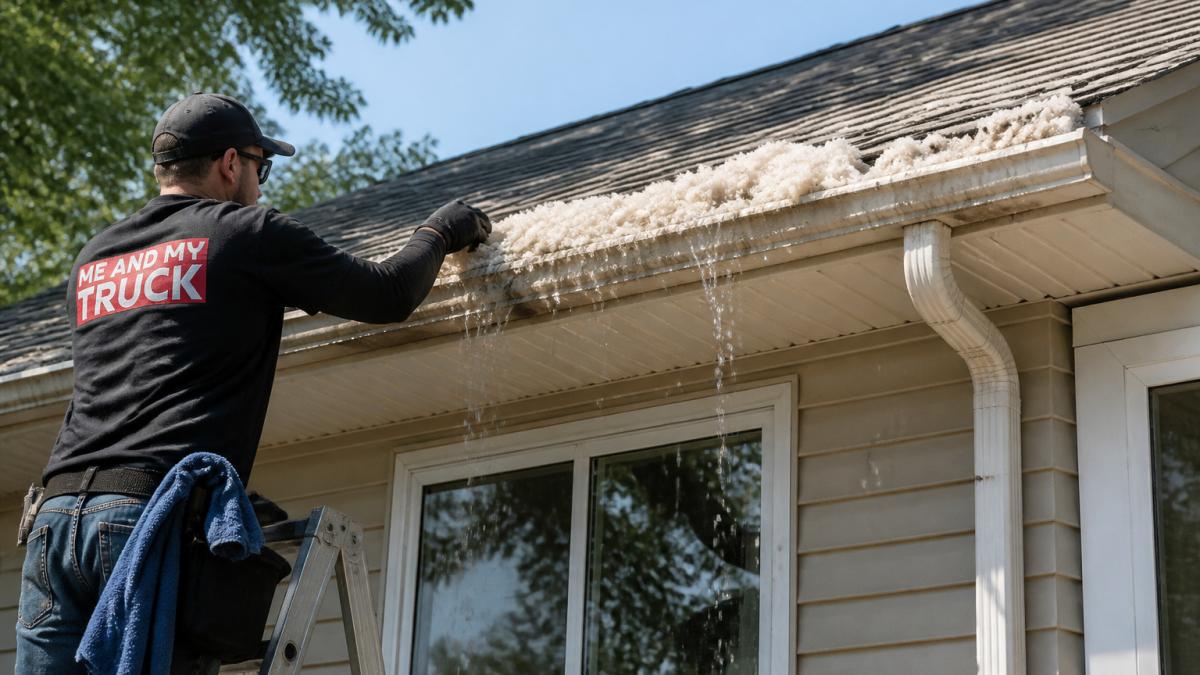
Check it during a storm if you can. For practical steps to stop gutter overflow during rain, see our seasonal maintenance tips. Look for:
- Water running over the front lip of the gutter
- Puddles or splash marks at the base of the house
- Water dripping from the same spots every time it rains
If your gutters are overflowing, the fluff inside is the likely culprit. A quick look from the ground with a flashlight will tell you enough.
Sign 2: Gutters Sagging or Pulling Away From the Fascia
A sagging gutter run is easy to miss from the ground, but it’s one of the more telling signs that fluff has been sitting in the trough for a while.
How to check it from the ground:
- Stand at one end of the house and sight down the gutter line against the roofline. For a full step-by-step on working safely with a ladder, see how to clean high gutters safely. A healthy run looks like a straight, even line. A sagging run dips in the middle or waves up and down.
- Look at the gap between the back of the gutter and the fascia. A thin, even shadow line is normal. A widening gap, especially near a downspout or at a seam, means the gutter is pulling loose.
- Check the hangers (the metal straps or spikes holding the gutter up). You don’t need to climb. From a ladder at the end of the run, look for hangers that have pulled out of the fascia or bent downward.
- Watch where water goes during the next rain. A sagging section will overflow at the low point even if the rest of the run looks clear, because water pools there instead of reaching the downspout.
Why cottonwood makes this worse than leaves: Leaves tend to sit on top of each other and stay somewhat loose, so water can still trickle past. Wet fluff mats into a felt-like sheet that seals the bottom of the trough.
What to do about it: Cleaning out the fluff and grit removes the weight and lets you see whether the gutter springs back or stays sagged.
If you’d rather have someone take a look while the gutters are being cleaned, Me And My Truck can help. Call or text (208) 882-5641 or send a photo for a quote.
Sign 3: Sprouts, Moss, or Weeds Growing Inside the Gutter
Fluff holds moisture. Dirt collects on top of it. Before long, seeds find that mix and sprout right inside the gutter. A few small sprouts or a patch of moss in the trough is a clear sign the gutter has been holding debris for a while.
Look at the gutter from the ground with binoculars. Green growth in the trough means the gutter isn’t draining. If you see it, plan a cleaning soon.
Sign 4: Staining and Dark Streaks on the Siding Below
When a clogged gutter overflows, water runs down the siding instead of staying in the gutter. That leaves dark streaks under the gutter line, and sometimes stains on the trim or near the windows.
Check the siding right under the gutters, especially at the corners and near the downspouts. Streaks that follow the same path every time it rains point to a gutter problem.
Keep an eye on this one. If the streaks are heavy or spreading, give us a call at (208) 882-5641 and we’ll point out what we see.
Sign 5: Fluff Packed Into Downspouts and Debris Spilling Over the Edge
This is the sign most generic gutter articles skip, and it’s the one that matters most with cottonwood. Fluff doesn’t just sit in the trough, it travels.
What a cottonwood downspout clog looks like:
- Fluff sticking out of the bottom of the downspout, or a gray-tan felt-like wad visible at the outlet.
- Debris spilling over the front edge of the gutter near the downspout, even when the rest of the run looks okay.
- Water backing up at the outlet during rain and running over the side instead of down the spout.
- A downspout that stays dry at the bottom during a hard rain, that means nothing is getting through.
How fluff differs from a leaf clog: A leaf clog usually forms a dam across the gutter channel. You can see it, and water pools behind it.
A simple flow test you can do from the ground:
- On a dry day, run a garden hose into the gutter near the downspout, or have someone on a ladder do it while you watch from below.
- Watch the bottom of the downspout. A steady, full stream means it’s clear. A trickle, a gurgle, or nothing means it’s packed.
- If water backs up at the outlet and runs over the gutter lip, the clog is at the top of the downspout.
- If water goes in but never comes out the bottom, the clog is somewhere in the run.
Clearing it: From the top, feed a garden hose down the downspout with the nozzle off.
When we clean gutters by hand, we clear the trough and check the downspouts, and we haul all the debris away so you’re not left with a pile of wet fluff on the lawn. You can book gutter cleaning in Moscow and Pullman with us anytime. If you’d rather not do the climbing, Me And My Truck can help. Call or text (208) 882-5641 or send a photo for a free quote.
Here’s a quick way to tell which problem you have, based on what you see at the downspout.
|
What you see |
What it usually means |
What to do |
|---|---|---|
|
Fluff sticking out of the downspout bottom |
Clog packed into the downspout |
Clear from the top with a hose or brush |
|
Debris spilling over the gutter lip near the downspout |
Outlet is blocked |
Check the top of the downspout first |
|
Water backs up and runs over the side |
Clog sits at the top of the downspout |
Feed a hose down the spout, nozzle off |
|
Downspout stays dry in a hard rain |
Nothing is getting through |
Clear the run and the spout |
|
Gutter looks clear but downspout is plugged |
Fluff traveled into the outlet |
Run a flow test from the ground |
How Often to Clean Gutters
For most Palouse homes, once or twice a year is right. Cottonwood season is the big one, and fall is the other common time, once leaves drop.
If your home sits under a lot of trees or your gutters clogged badly last year, you may want the spring cleaning on your calendar every year. Don’t go more often than twice a year.
Gutter Cleaning by Hand: Safe Steps and Checking Downspouts After
If you’d rather clean them yourself, here’s how we’d approach it. Take it slow, and don’t go up if you’re not comfortable.
What you’ll need:
- A sturdy ladder on firm, level ground
- Gloves
- A small scoop or gutter trowel
- A bucket or tarp to catch debris
- A garden hose with a spray nozzle
Steps:
- Pick a dry day with no wind. Wet fluff is heavy and slippery.
- Set the ladder on firm, level ground. Have someone hold the base if you can.
- Wear soft-soled shoes and keep both feet on the rungs.
- Scoop the fluff and grit out by hand. Drop it into the bucket or onto a tarp, not on the ground below where you walk.
- Flush the gutter with the hose from the far end toward the downspout.
- Check the downspout. Run water down it and watch the flow at the bottom. If it backs up, the downspout is still clogged.
- Clear the downspout with a hose or a long brush from the top.
Watch out: Never lean far off the ladder to reach a spot. Move the ladder instead. Falls are the real danger here.
If you’d rather not do the climbing, Me And My Truck is happy to handle it. Call or text (208) 882-5641 or send a photo for a free quote.
Frequently Asked Questions
How can I tell if my gutters are clogged with cottonwood fluff?
Look for a soft, cottony mat sitting in the gutter, often mixed with loess dust and small seeds. If water runs over the edge during a rain instead of flowing into the downspout, the trough is probably packed. A quick look from a stable ladder on a dry day will usually show it. Pull a handful out: if it feels spongy and damp underneath, the gutter is holding water and needs cleaning soon.
Can I clean my own gutters by hand?
Yes, and many homeowners do. Wear gloves and eye protection, use a sturdy ladder on firm, level ground, and never lean out past your belt buckle. Scoop debris by hand into a bucket, then flush the trough with a garden hose and check that water exits the downspout. Put the debris in a bag and haul it away. If the ladder or roof pitch makes you uneasy, Me And My Truck can help. Call or text (208) 882-5641 or send a photo for a quote.
How often should gutters be cleaned?
Once or twice a year is right for most homes here: once in late fall after the cottonwoods drop their fluff and leaves, and sometimes again in spring. Cleaning more often than that rarely helps and only adds time on the ladder. Clean gutters are better prepared for freeze-thaw season.
Why should I check my gutters before winter?
A gutter full of wet fluff and grit can freeze solid, which holds water against the fascia and pulls on the hangers. Palouse winters bring freeze-thaw cycles, and small clogs can turn into bigger problems over time. Clearing them in late fall gives melting snow and rain a clear path to the downspouts. Call or text (208) 882-5641 or send a photo for a free quote.